
LED teeth whitening has become increasingly popular in Ho Chi Minh City’s cosmetic dentistry sector, with international patients drawn to the technology’s promise of faster, more effective whitening. However, scientific research presents a more nuanced picture of LED light’s actual contribution to bleaching outcomes.
LED teeth whitening: How does it functions?
The teeth whitening LED light systems used in professional settings differ significantly from consumer products in power output, wavelength precision, and integration with clinical-grade bleaching agents.
How professional LED teeth whitening works
The process combines hydrogen peroxide or carbamide peroxide gel with LED light exposure in controlled cycles:
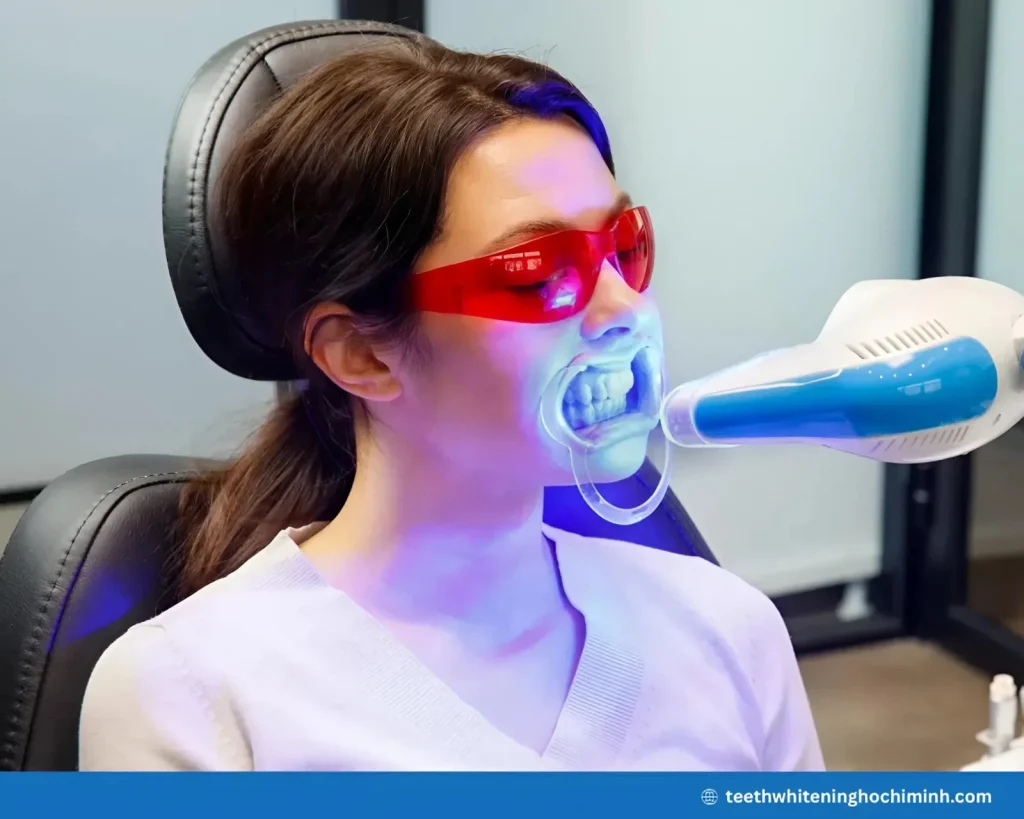
Gel application phase: Dentists apply 15-40% hydrogen peroxide or 20-37% carbamide peroxide directly to tooth surfaces. Protective barriers shield gum tissue from chemical contact.
Light activation cycles: LED devices emit specific wavelengths (typically 450-490nm for blue LED, 405-410nm for violet LED) that supposedly accelerate the oxidation process. Treatment involves 2-4 cycles of 15-20 minutes each.
Chemical reaction enhancement: The theory suggests LED energy excites peroxide molecules, increasing oxygen release that breaks down stain molecules embedded in enamel.
The science behind LED light activation
Research reveals complex findings about LED effectiveness:
| Study Type | Key Finding | Clinical Significance |
| 2011 Critical Appraisal | Light sources provide minimal additional whitening beyond peroxide alone | High concentrations of chemicals primarily responsible for results |
| 2024 Systematic Review | LED light may enhance effectiveness without increasing sensitivity | Mixed evidence requires more clinical trials |
| Violet LED Studies (2022-2023) | Violet LED (405-410nm) produces color changes even without peroxide | Promising but requires long-term safety confirmation |
| Temperature Studies | LED systems generate insufficient heat to damage teeth | Safety confirmed for properly used devices |
The scientific consensus suggests LED activation provides marginal improvement over chemical action alone, with most whitening occurring through peroxide’s oxidation rather than light energy.
>>> More details here: Laser Teeth Whitening Is It Safe? 7 Things You Should Know
Types of LED systems available in HCMC
Ho Chi Minh City dental clinics employ various LED technologies representing different generations of whitening innovation.
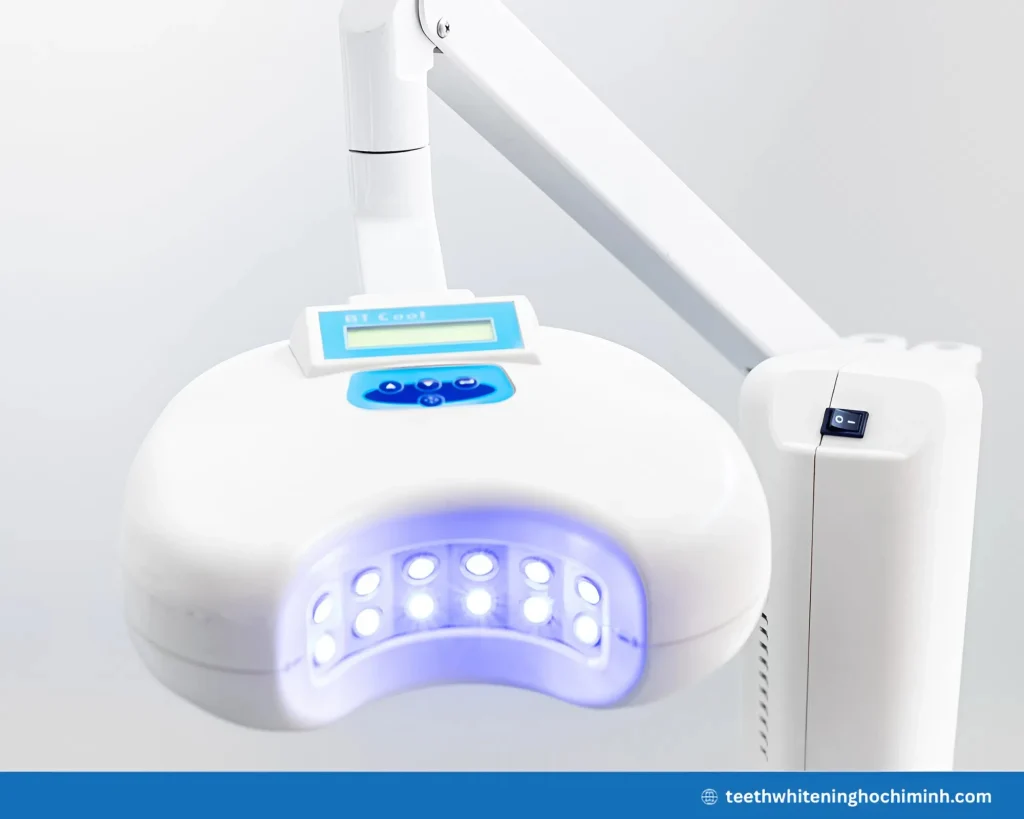
Blue LED systems (450-490nm)
Traditional blue light systems represent the most common technology in HCMC clinics.
Characteristics:
- Wavelength range: 460-490 nanometers
- Activates standard peroxide formulations
- Treatment time: 60-90 minutes total
- Minimal heat generation
Common brands in HCMC: Zoom WhiteSpeed, Beyond Polus, BriteWhite systems
Clinical performance: Studies show blue LED combined with 35-38% hydrogen peroxide achieves 3-8 shade improvement. However, research indicates similar results occur with gel alone given equivalent contact time.
Violet LED technology (405-410nm)
Newer violet LED systems have gained attention for unique properties approaching ultraviolet teeth whitening spectrum wavelengths.
Distinguishing features:
- Wavelength: 405-410nm (closer to UV than blue LED)
- May produce whitening without peroxide in some cases
- Potentially gentler on enamel
Research findings: A 2022 study found violet LED alone (without peroxide) produced detectable color changes, though less dramatic than peroxide-based treatments. When combined with low-concentration peroxide (16% carbamide), violet LED achieved results comparable to higher-concentration chemical bleaching.
Safety considerations: The proximity to UV wavelengths initially raised concerns, but research confirms no genotoxic effects or enamel damage when used properly.
Laser vs LED: Key differences
Some HCMC clinics market “laser teeth whitening” alongside LED options, creating confusion about distinctions.
| Criteria | LED | Laser |
| Light Characteristics | Broader light spectrum | Focused single-color light beam |
| Intensity | Lower intensity | Higher intensity focused application |
| Operating Temperature | Cooler operation | Generates more heat (requires careful monitoring) |
| Equipment Cost | Less expensive equipment | Premium pricing |
| Patient Suitability | Suitable for most patients | Needs thorough patient evaluation |
| Results | Standard treatment timeline | Potentially faster results for stubborn stains |
| Activation Mechanism | Activates peroxide based on gel concentration and contact time | Activates peroxide based on gel concentration and contact time |
Note: Both technologies activate peroxide similarly, with effectiveness depending more on gel concentration and contact time than light source type.
LED teeth whitening pros: Evidence-based benefits
Objective assessment reveals genuine advantages of professional teeth whitening LED light treatments when properly administered.
- Time Efficiency: Single 60-90 minute appointments vs. multiple sessions—ideal for patients with limited time
- Standardized Protocol: LED acts as built-in timer, ensuring consistent gel contact time and reducing outcome variability
- Enhanced Patient Experience: Visual treatment component increases satisfaction and comfort perception
- Reduced Sensitivity: Some studies suggest more efficient oxidation may require less peroxide exposure, potentially lowering sensitivity
LED teeth whitening cons: Limitations and concerns
Balanced evaluation requires acknowledging evidence-based limitations of LED teeth whitening technology.
Constraints of scientific research
- Minimal enhancement: Research shows LED adds only 0.2-1.5 shade units vs. gel alone – often imperceptible to the human eye
- Chemical action dominates: Studies confirm 90%+ of whitening occurs through peroxide oxidation, not LED activation
- Marketing gap: Clinics emphasize LED technology while the chemical gel does the actual work
Cost considerations
Premium pricing for marginal benefit:
LED teeth whitening near me clinics in HCMC charge 30-60% more than gel-only treatments despite minimal proven effectiveness difference. For budget-conscious patients, take-home tray systems deliver equivalent results at lower cost.
| Treatment Type | HCMC Average Cost | Results Timeline | Cost Per Shade |
| LED in-office | $100-260 USD | Single visit | $15-40 per shade |
| Laser in-office | $150-300 USD | Single visit | $20-50 per shade |
| Take-home trays | $40-80 USD | 2-3 weeks | $6-12 per shade |
| Non-LED in-office | $60-120 USD | 1-2 visits | $10-20 per shade |
Crucial considerations for international visitors
The premium cost of LED systems primarily purchases convenience (single-visit completion) and professional supervision rather than dramatically superior results. For patients with limited time in HCMC, this convenience justifies the investment.
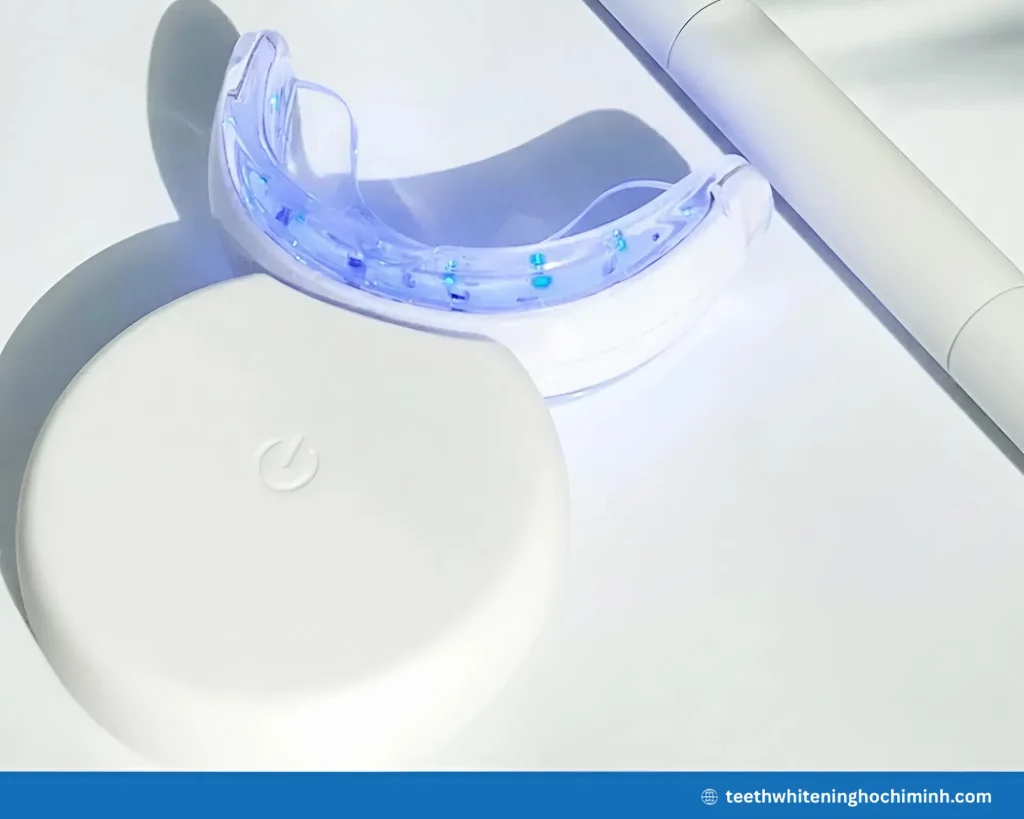
Take-home professional trays deliver equivalent whitening at 40-60% lower cost for patients able to commit 10-14 days. The extended timeline proves negligible for residents or longer-term visitors. Regardless of technology chosen, results depend on original tooth color, stain type, enamel characteristics, and post-treatment care rather than LED light exposure.
HCMC’s competitive dental market provides excellent value for LED whitening compared to Western countries, with savings of 60-75% even for premium services. The cost advantage makes trying LED technology more accessible for curious patients.
LED teeth whitening – FAQs
What is LED teeth whitening?
LED teeth whitening uses specific wavelength light (typically 450-490nm blue or 405-410nm violet) to supposedly activate peroxide-based bleaching gel, though research shows minimal effectiveness enhancement beyond chemical action alone.
Where can I find the best LED teeth whitening near me in HCMC?
Elite Dental, Platinum Dental, and Saigon Center Dental offer top-rated professional teeth whitening LED light systems with English-speaking staff serving international patients throughout Ho Chi Minh City.
How much does LED teeth whitening cost in Ho Chi Minh City?
Professional LED teeth whitening in HCMC ranges from $100-260 USD depending on clinic, system used, and included services—significantly below Western market rates of $400-800 USD.
What are the LED teeth whitening pros and cons?
Pros include single-visit convenience, immediate results, and professional supervision; cons include minimal proven effectiveness enhancement over non-LED methods, premium pricing, and potential sensitivity.
Is LED light actually effective for teeth whitening?
Research shows LED provides marginal improvement (0.2-1.5 shade units) beyond peroxide’s chemical action alone, with most whitening occurring through oxidation regardless of light activation.
Does LED teeth whitening damage enamel?
Short-term studies confirm LED systems don’t damage enamel when used properly, though long-term effects of repeated treatments remain understudied; concern applies to bleaching chemicals rather than LED light itself.
How does LED teeth whitening compare to laser whitening?
Both activate peroxide similarly with comparable results; laser uses concentrated single-wavelength beam versus LED’s broader spectrum, but effectiveness depends more on gel concentration than light source type.
Which is better: blue LED or violet LED teeth whitening?
Violet LED (405-410nm) shows promise for producing whitening with lower peroxide concentrations, but blue LED (450-490nm) has more extensive safety research; clinical differences remain minimal.
Can I get LED teeth whitening if I have sensitive teeth?
Yes, but inform dentists beforehand for gel concentration adjustment and pre-treatment desensitizing protocols; some studies show LED increases sensitivity while others find no difference versus non-LED bleaching.
How long do LED teeth whitening results last?
Results typically persist 12-18 months regardless of LED use, with longevity depending on oral hygiene, dietary habits, and tobacco avoidance rather than whitening technology employed.
Conclusion
The best LED teeth whitening clinics in Ho Chi Minh City combine modern technology with qualified practitioners and international patient service standards. Elite Dental, Platinum Dental, and Saigon Center Dental represent reliable options employing various LED systems at competitive pricing. For a broader look at all in-office whitening options – including laser, Zoom, and other professional methods – see our detailed guide on In Office Teeth Whitening Ho Chi Minh.
However, evidence-based analysis reveals LED light provides marginal effectiveness enhancement beyond peroxide’s chemical action. The technology’s primary benefits lie in treatment convenience, professional supervision, and structured protocols rather than revolutionary whitening capability.
International patients should select treatments based on schedule constraints, budget considerations, and personal preferences rather than assuming LED superiority. For time-pressed tourists, LED’s single-visit convenience justifies premium pricing. For budget-conscious patients or residents, take-home professional trays deliver equivalent results at significantly lower cost.
>>> Read more: Professional Teeth Whitening Bleach – Top Dentist Picks
Teeth Whietning in Ho Chi Minh City provides comprehensive, evidence-based evaluation of cosmetic dentistry services throughout Vietnam’s major cities. The platform analyzes LED teeth whitening and other in office teeth whitening services through scientific research review, verified patient testimonial assessment, clinic facility evaluation, and pricing transparency comparison. By presenting both advantages and limitations of various whitening methods, the site helps international patients make informed decisions aligned with individual needs, budgets, and expectations rather than marketing claims.
